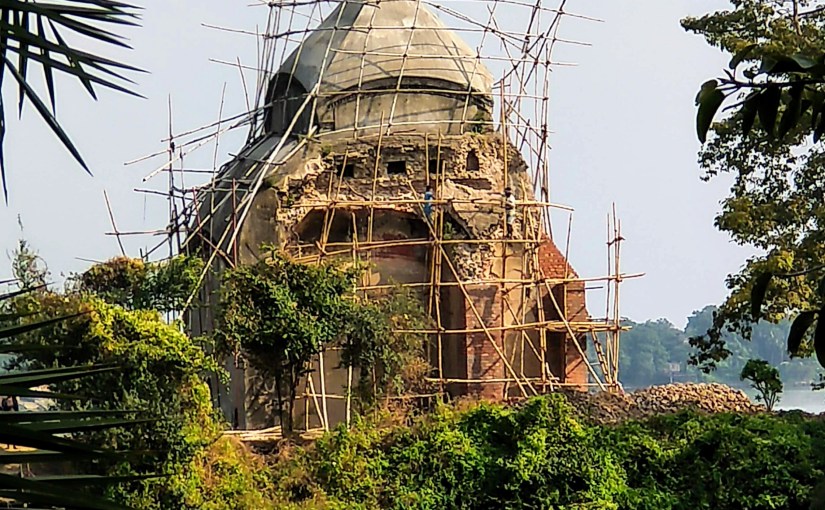
Serampore, a sub-divisional town in Hooghly district of West Bengal is only about 18 kilometres from Howrah. It is the eight station in Howrah-Bandel line of the Eastern Railway. The Grand Trunk Road passes through this town. The town can be reached either by road or by water; other than the rail route. This town has a rich history to offer. The Danes named this town as Fredericknagar in 1757 in the name of the then King Frederick V of Denmark.
Continue reading Henry Martin’s PagodaAbout

Shandeswartala Temple, Chinsurah
Chinsurah or Chuchura is the district headquarters of Hooghly. It is situated about 37 kilometers north of Kolkata by the western side of the Ganges. This town was previously a Dutch settlement till 1825. The town had a number of heritage monuments.
Continue reading Shandeswartala Temple, Chinsurah
Bhukailash Temple, Khidirpur
Situated in Khidirpur, in Ward No 79 of Kolkata Municipal Corporation (KMC) Bhukailash Rajbari is a prominent place where one will witness two big aatchala Shiva temples – Raktakamaleswar and Krishnachandreswar standing there from 1780 onwards and which have archaeological, architectural and historical significance. The temples along with the thakurbari including gateway of Bhukailash Rajbari is a Grade-I Heritage of the KMC.
Continue reading Bhukailash Temple, Khidirpur
Jateswara Shiv Mandir, Mahanad
Mahanad, a village about 13 kilometers from Tribeni in Chinsurah sub division of Hooghly district of West Bengal has a historical importance. Apart from the famous Mahanad Kali Mandir, there is another Shiva Temple dedicated to Jateswara Shiva. The god of Nath sect of Mahanad is Jateswara Shiv. It is not known as to when the Jateswara Shiva Temple was built; but considering the temple architecture it is assumed that it was built in the middle of the eighteenth century; though later the temple was renovated by Tarak Chandra Saha.
Continue reading Jateswara Shiv Mandir, Mahanad
Tulsimancha
Manchas are of three types – rasmancha, dolmancha and tulsimancha. In my previous blog posts I have written about Rasmancha and Dolmancha. Today I will concentrate on tulsimancha. Of the three manchas, tulsimancha is the smallest and is mainly found in domestic households and also in many temples of West Bengal. A tulsimancha is built centering a tulsi tree.
Continue reading Tulsimancha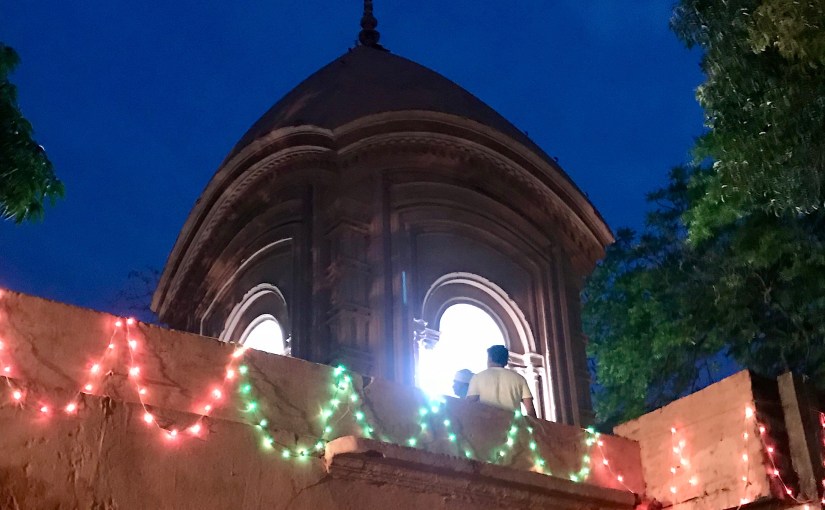
Dolmancha
Manchas are of three types – dolmancha, rasmancha and tulsimancha. Of these tulsimanchas are present not only in domestic households but also in many temples of West Bengal. Of the three a rasmancha is larger than a dolmancha while the latter is larger than a tulsimancha. According to David McCutchion, “The dolmancha was most commonly built in the eighteenth century, …… they are spread over the whole of Bengal, wherever Krishna was worshipped.”
Continue reading Dolmancha
Dadhimadhav Temple, Amragiri, Howrah
There are a number of temples rich in terracotta in Amta II block of Howrah district of West Bengal namely in the villages of Jhikira, Rautara and Amragiri. Coming from Howrah, the first village is Amragiri on your right.
Continue reading Dadhimadhav Temple, Amragiri, Howrah
Temples of Hadal Narayanpur
When we speak of terracotta temples, the first thing that comes to our mind is Bishnupur in Bankura district of West Bengal. But terracotta temples are spread in different districts of the state and, in particular, in many areas of Bankura district namely Kotulpur, Gokulnagar, Joypur, Hadal Narayanpur to name a few. The twin villages of Hadal Narayanpur is located about five kilometres from the nearest railway station Dhagaria in the Bankura Damodar Railway (BDR) of South-Eastern section of the Indian Railways. It is situated on the southern banks of Bodai river, a tributary of River Damodar.
Continue reading Temples of Hadal Narayanpur
Temples of Joynagar
Joynagar, a town and muncipality of South 24 Parganas district, situated just 31 miles south of Kolkata, has a number of temples but which made Joynagar famous is for the confectionary of Joynagarer Moa.
Continue reading Temples of Joynagar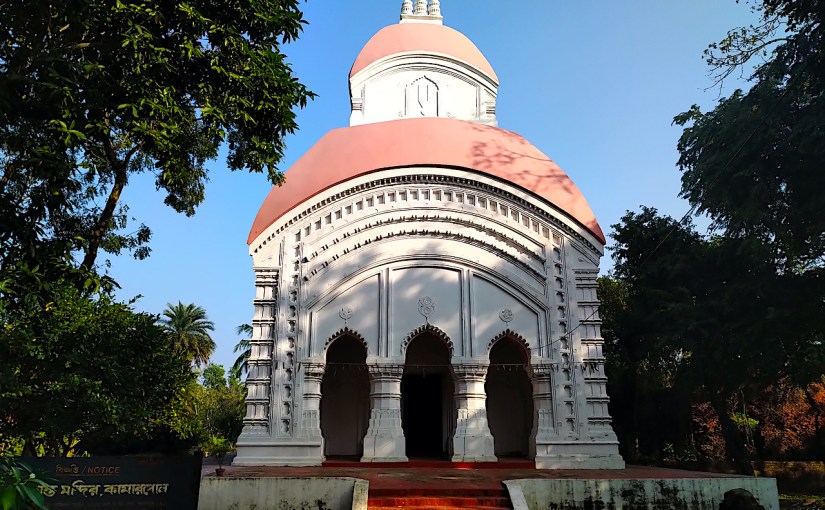
Temples of Kamarpole, South 24 Parganas
South 24 Parganas has a number of heritage places of which Kamarpole is one in which one will come across a number of temples, rasmancha, dolmancha and even tulsimancha in one complex.
Continue reading Temples of Kamarpole, South 24 Parganas
Temples of Patrasayer, Bankura
Patrasayer, a community development block under Bishnupur subdivision of Bankura district houses a number of temples of which Kalanjay Shiva Temple deserves special mention.
Continue reading Temples of Patrasayer, Bankura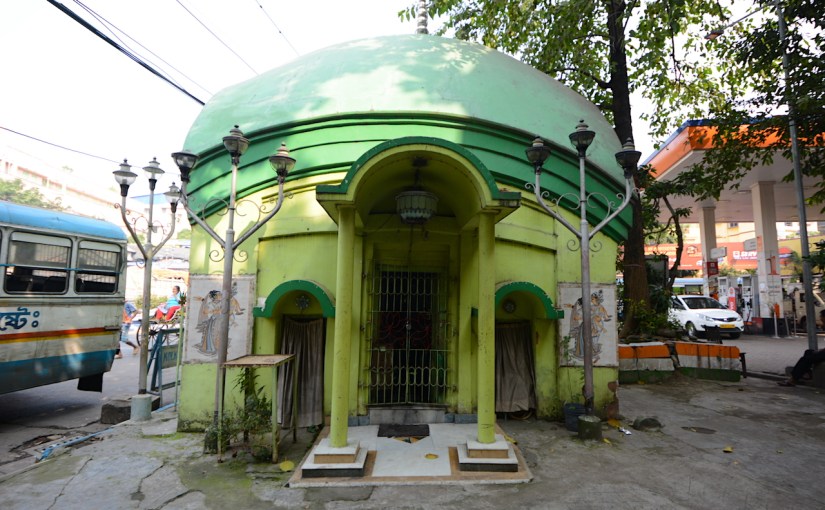
Dochala Siva Temple
There are a very large number of Siva temples in Kolkata; of which some are pretty old and each follows a distinct temple architecture. Bagbazar situated towards the north of Kolkata has a number of temples of which one temple on the eastern pavement of Kshirode Vidyavinode Avenue drew my attention. This temple is dedicated to Lord Shiva.
Continue reading Dochala Siva Temple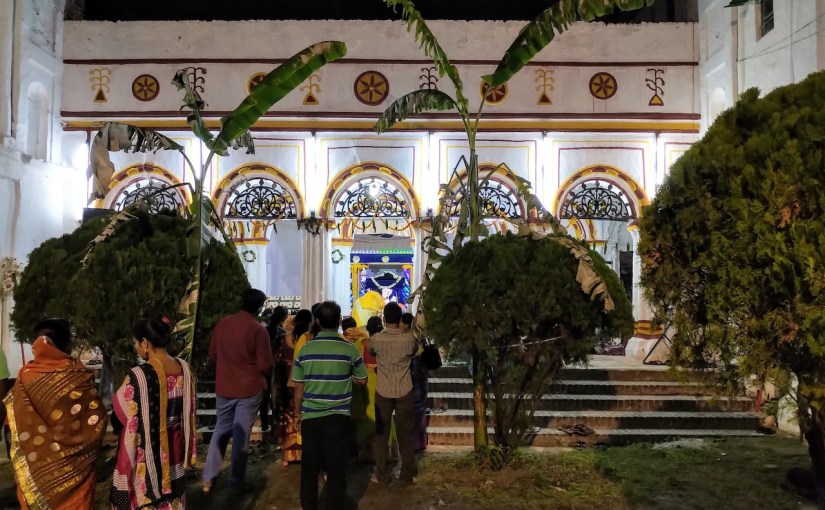
Cossipore Rasbati
Cossipore had a number of old temples and heritage places which dates back to history. Being a frequent visitor there I found a very old rasmancha inside a math (open space) at Ratan Babu Road. This structure aroused my interest and that actually led me to visit there to trace its history. On one of my visit to the nearby Baranagar, I met respected Late Ajit Sen, and from his books, I gathered some information about this Rasbati.
Continue reading Cossipore Rasbati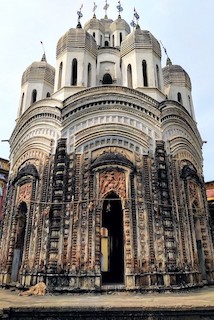
Rasmancha
Manchas are of three types – rasmancha, dolmancha and tulsimancha. A rasmancha (a temple-like structure generally octagonal in shape with the sides open and situated on a raised-platform) is the largest among the three. It was very common in the nineteenth century Bengal. The rasmancha is normally smaller in size than the main temple where the Radha Krishna deities reside throughout the year. The main purpose of building the rasmancha is to enable the people to witness the deities (here Radha Krishna) from all the sides on a special occasion (Rashyatra).
Continue reading Rasmancha
Jagaddhatri Puja of Krishnanagar Rajbari
Jagaddhatri Puja, the main festival of Krishnannagar is a one day puja on the day of Nabami normally held in the month of November every year. The star attraction of this festival is the Jagaddhatri Puja of Krishnanagar Rajbari, started by Maharaja Krishna Chandra (1728-1782). It was roughly in 1762. From then onwards the puja is still being celebrated in the same natmandir with great pomp and splendour.
Continue reading Jagaddhatri Puja of Krishnanagar Rajbari

You must be logged in to post a comment.