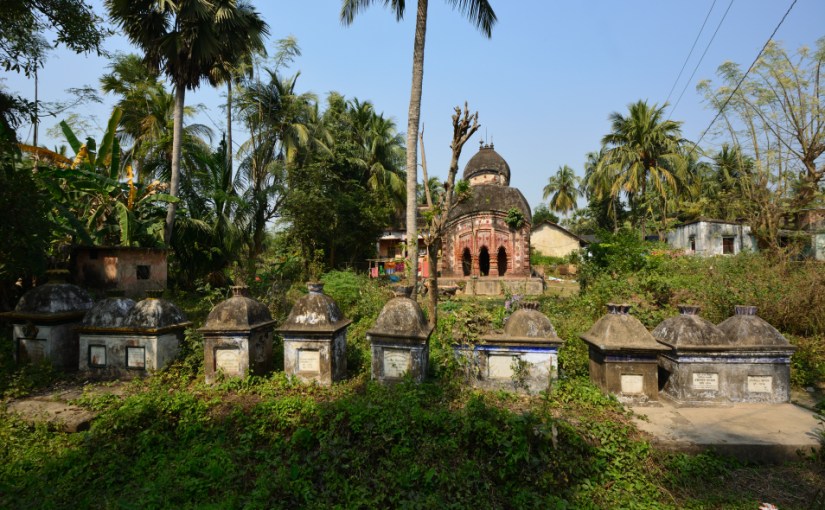
This year in February I had been to the village of Jhikira in Amta II block of Howrah district to witness the terracotta temples of the region. After visiting the temples of Rautara, I crossed the road and came to the other side. I had to walk through the village road in search of temples. This area has a number of temples and according to David McCutchion “the temples of Howrah are an extension of those predominating in the adjoining district of Hooghly”.
Continue reading Temples of Jhikira, HowrahCategory: Howrah

Tulsimancha
Manchas are of three types – rasmancha, dolmancha and tulsimancha. In my previous blog posts I have written about Rasmancha and Dolmancha. Today I will concentrate on tulsimancha. Of the three manchas, tulsimancha is the smallest and is mainly found in domestic households and also in many temples of West Bengal. A tulsimancha is built centering a tulsi tree.
Continue reading Tulsimancha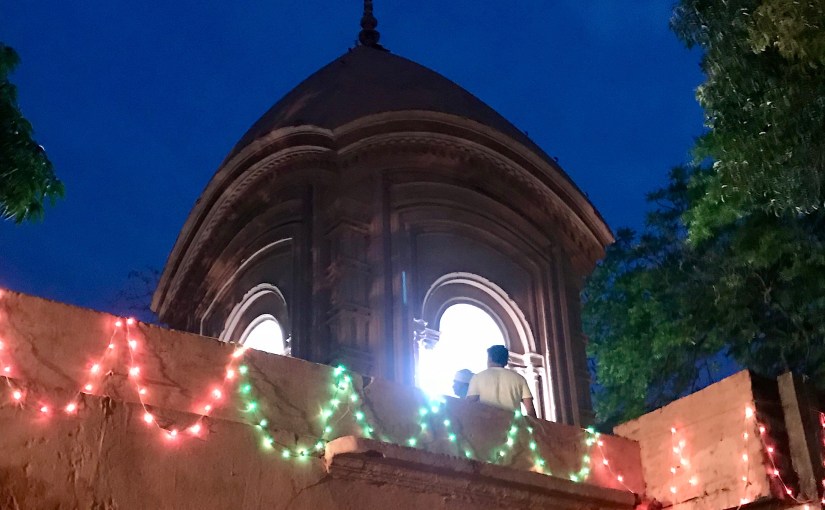
Dolmancha
Manchas are of three types – dolmancha, rasmancha and tulsimancha. Of these tulsimanchas are present not only in domestic households but also in many temples of West Bengal. Of the three a rasmancha is larger than a dolmancha while the latter is larger than a tulsimancha. According to David McCutchion, “The dolmancha was most commonly built in the eighteenth century, …… they are spread over the whole of Bengal, wherever Krishna was worshipped.”
Continue reading Dolmancha
Dadhimadhav Temple, Amragiri, Howrah
There are a number of temples rich in terracotta in Amta II block of Howrah district of West Bengal namely in the villages of Jhikira, Rautara and Amragiri. Coming from Howrah, the first village is Amragiri on your right.
Continue reading Dadhimadhav Temple, Amragiri, Howrah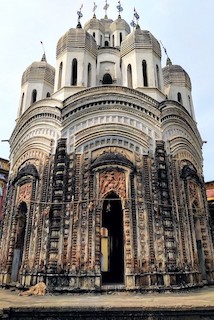
Rasmancha
Manchas are of three types – rasmancha, dolmancha and tulsimancha. A rasmancha (a temple-like structure generally octagonal in shape with the sides open and situated on a raised-platform) is the largest among the three. It was very common in the nineteenth century Bengal. The rasmancha is normally smaller in size than the main temple where the Radha Krishna deities reside throughout the year. The main purpose of building the rasmancha is to enable the people to witness the deities (here Radha Krishna) from all the sides on a special occasion (Rashyatra).
Continue reading Rasmancha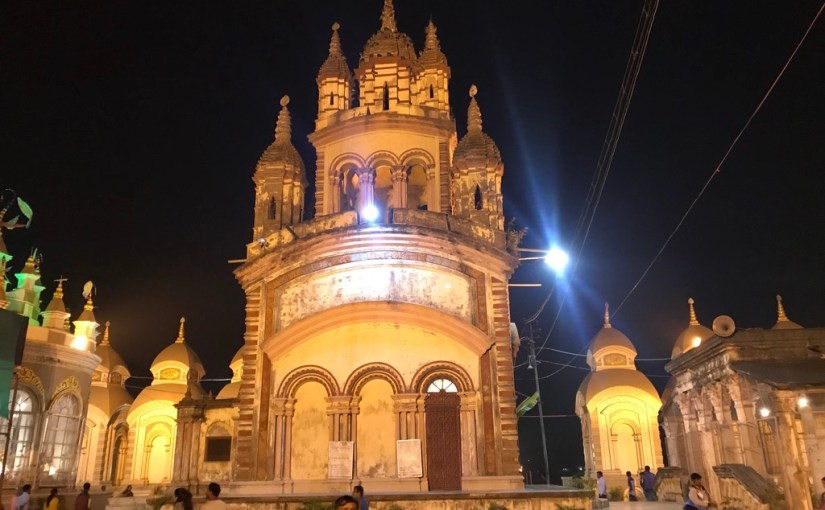
Rasbari Garden House, Belur, Howrah
Belur Rasbari in Howrah district of West Bengal is located close to Belur Math and just opposite to Kuthi Ghat in Baranagar on the other side of the Ganges. This Rasbari was founded by Purna Chandra Dawn, eldest son of Shiv Krishna Dawn of Jorasanko on 21st Jaistha, 1297 and according to Gregorian calendar it was in June, 1890.
Continue reading Rasbari Garden House, Belur, Howrah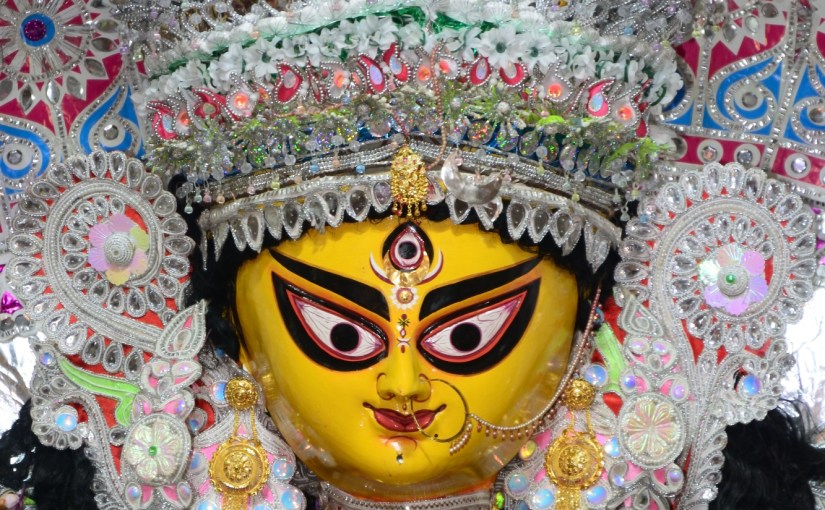
Durga Puja of Howrah’s ‘Bonedi’ families (Part-II)
In my first blog on Howrah’s ‘bonedi‘ families published a few days back, I have covered the houses of Bally, Belur and Salkia. But there are also some houses in Andul and Shibpur, where Durga Puja is not only old but also equally famous. In Part-II of my blog on Durga Puja of Howrah’s ‘bonedi‘ families, I try to include them.
Continue reading Durga Puja of Howrah’s ‘Bonedi’ families (Part-II)
Durga Puja of Howrah’s ‘Bonedi’ families (Part-I)
1. Buri Maar Aaatchala, Chaitalpara, Bally
According to Shri Suniti Ganguly, Vice-President of Bally Chaitalpara Buri Maar Aatchala Puja Committee, this puja dates back to nearly 400 years and was started during the reign of Mughal Emperor Shah Jahan. Acutally this puja was a household puja but now it has been taken over by the puja committee. This puja is named as Buri Maar puja only because of its age; it started nearly four centuries back.
Continue reading Durga Puja of Howrah’s ‘Bonedi’ families (Part-I)
Coomar’s Shiv Mandir, Bally
One can find a number of old temples in Bally of Howrah district. One such old temple, I mean two old aatchala temples in one raised platform at 15, Kali Prasanna Coomar (Kumar) Street (which was previously known as Sen Para) in Bally deserves mention. There are actually two temples placed side by side opposite to a pond known as Coomar (Kumar) Lake.
Continue reading Coomar’s Shiv Mandir, Bally
Twin Shiva Temples, Bally
Shiv Mandir (Temple) is pretty common in West Bengal and mostly they are of aatchala (eight rooofed) type. Among them some are pretty old and have undergone restoration and while others have not. Many contain terracotta panels and during restoration some got damaged. Another thing while undergoing restoration work, many temples lost its old charm.
Continue reading Twin Shiva Temples, Bally Blog of Kinjal Bose
You must be logged in to post a comment.