
Manchas are of three types – rasmancha, dolmancha and tulsimancha. In my previous blog posts I have written about Rasmancha and Dolmancha. Today I will concentrate on tulsimancha. Of the three manchas, tulsimancha is the smallest and is mainly found in domestic households and also in many temples of West Bengal. A tulsimancha is built centering a tulsi tree.
Continue reading TulsimanchaCategory: Hooghly
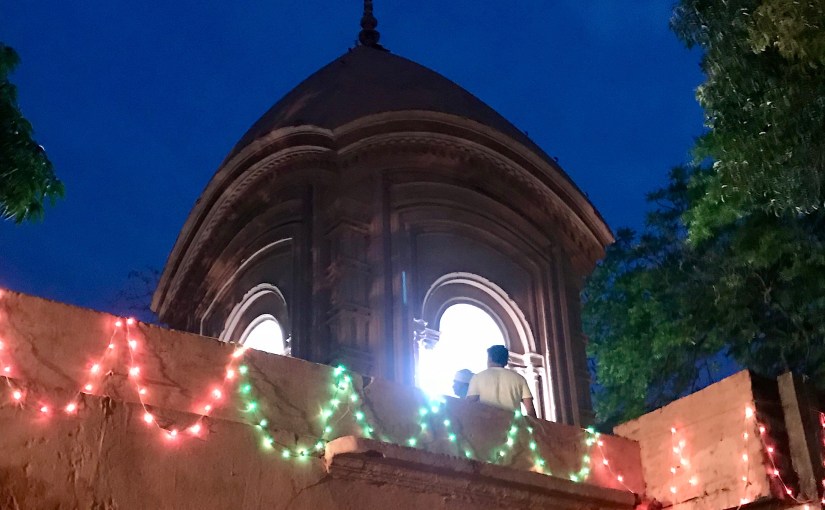
Dolmancha
Manchas are of three types – dolmancha, rasmancha and tulsimancha. Of these tulsimanchas are present not only in domestic households but also in many temples of West Bengal. Of the three a rasmancha is larger than a dolmancha while the latter is larger than a tulsimancha. According to David McCutchion, “The dolmancha was most commonly built in the eighteenth century, …… they are spread over the whole of Bengal, wherever Krishna was worshipped.”
Continue reading Dolmancha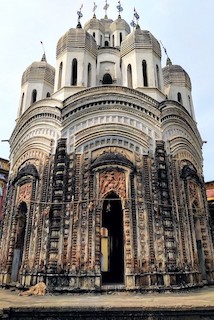
Rasmancha
Manchas are of three types – rasmancha, dolmancha and tulsimancha. A rasmancha (a temple-like structure generally octagonal in shape with the sides open and situated on a raised-platform) is the largest among the three. It was very common in the nineteenth century Bengal. The rasmancha is normally smaller in size than the main temple where the Radha Krishna deities reside throughout the year. The main purpose of building the rasmancha is to enable the people to witness the deities (here Radha Krishna) from all the sides on a special occasion (Rashyatra).
Continue reading Rasmancha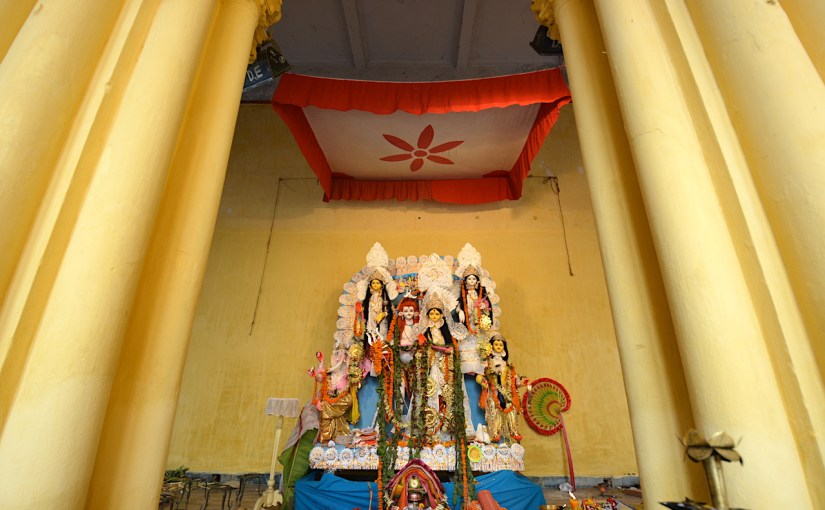
Durga Puja of ‘bonedi’ families of Chinsurah
In my previous blog the day before yesterday, I tried to cover the bonedi families of Chandannagar where Durga Puja is still being celebrated with great pomp and splendour. Chinsurah, the next station after Chandannagar is my today’s subject. Chinsurah was formerly a Dutch colony. Now Chinsurah or Chuchura is the headquarters of Hooghly district of West Bengal. There are a number of bonedi families in this town who are still worshipping Maa Durga maintaining the age-old tradition. In this blog I shall include five such families all of which were being covered by me on Nabami this year.
Continue reading Durga Puja of ‘bonedi’ families of Chinsurah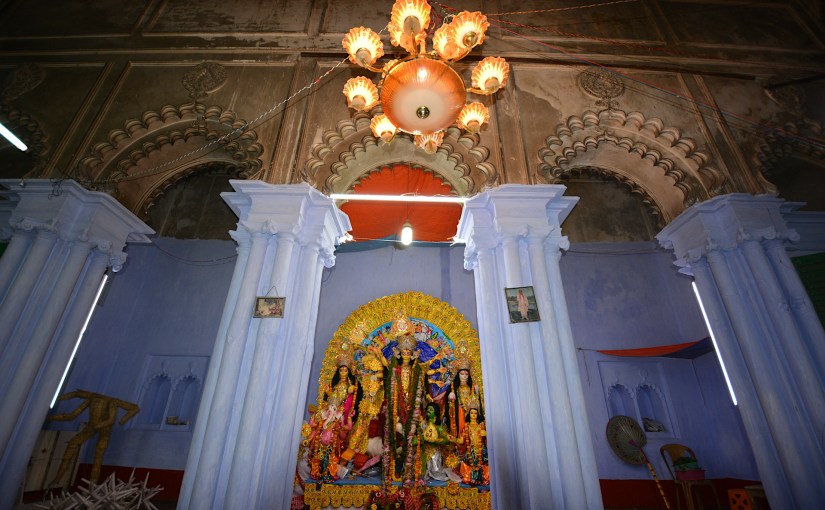
Durga Puja of ‘bonedi’ families of Chandannagar
Durga Puja is the greatest festival of the Bengalees. It is not only celebrated in the barowari puja pandals; but it is equally celebrated in many households of West Bengal. In my previous blogs I tried to cover the bonedi families of Kolkata and Howrah; though still a number of families left, which I hope to cover in the coming years. Chandannagar, a former French colony, just 35 kilometres from Kolkata, is famous for barowari Jagaddhatri Puja and lighting. But there are a number of bonedi families in this town who are celebrating Durga Puja with great pomp and splendour for many years. In this blog I tried to cover eight such families.
Continue reading Durga Puja of ‘bonedi’ families of Chandannagar
Rajrajeshwar Temple, North Chandannagar
Chandannagar, the 13th station from Howrah can be reached in less than an hour by train. It was a former French colony and can be reached by road and rail. The city has a number of heritage buildings and, therefore, has a rich history to offer. This city has a number of temples of which Rajrajeshwar Temple of North Chandannagar deserves special mention as far as intricate terracotta works are concerned. It is possibly the only surviving terracotta temple of Chandannagar.
Continue reading Rajrajeshwar Temple, North Chandannagar
Dasabhuja Mandir, Mankundu
Mankundu, being the 12th station in the Howrah-Bandel section of the Eastern Railway has a rich history to offer as far as the Dasabhuja Temple is concerned. The four hundred year old temple has beautiful and intricate terracotta works (though much of it has lost its original glory) and houses the deities of Dasabhuja in astodhatu (an alloy of eight metals) and Radha Krishna.
Continue reading Dasabhuja Mandir, Mankundu
Susanna Anna Maria’s Tomb, Chinsurah
Chinsurah or Chuchura is now the headquarters of Hooghly district of West Bengal. But Chinsurah was a Dutch colony during the period from 1635 to 1824. Though a long period has passed since then but the Dutch legacy still remained. One such is the tomb of Susanna Anna Maria, a Dutch lady who died in the year 1809.
Continue reading Susanna Anna Maria’s Tomb, Chinsurah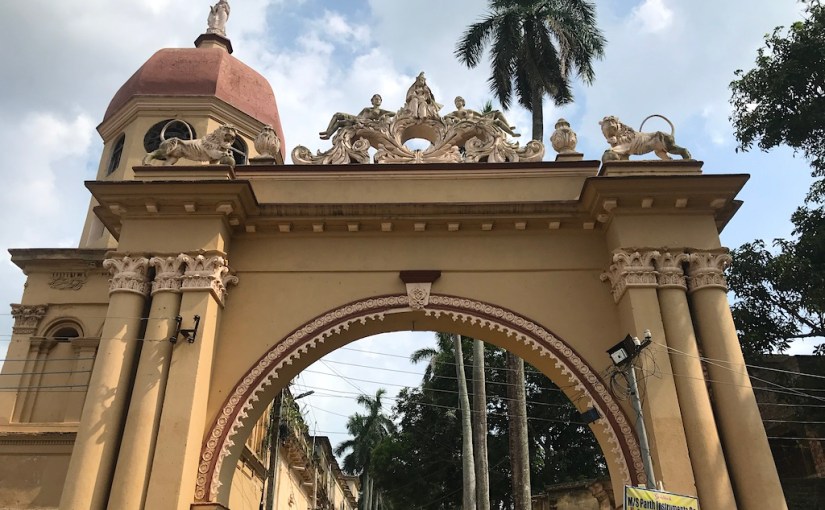
Dasghara
Located about 12 kms from the temple town of Tarakeshwar, Dasghara is famous for the pancharatna Gopinath temple with ridged rekha turrets containing exquisite terracotta works built in 1729 by Sadananda Biswas along with other temples and structures. The architectural splendour consists not only in temples but also in great mansions, clock towers and of course, the Rathyatra.
Continue reading Dasghara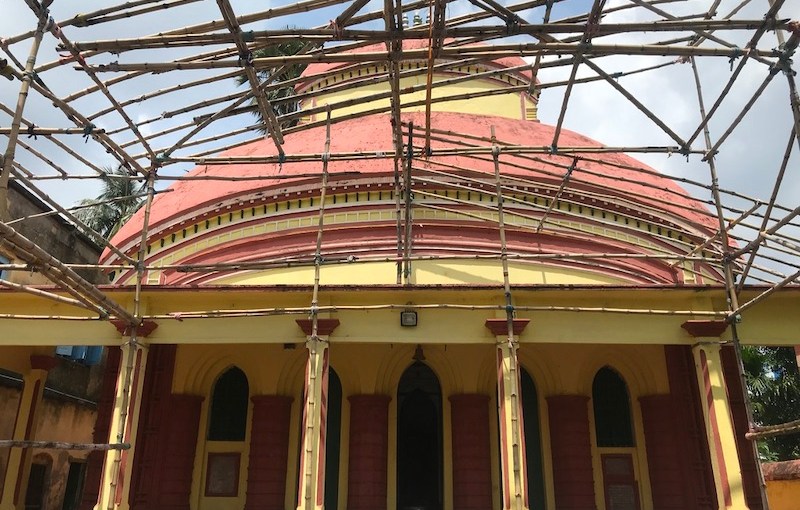
Madanmohan Mandir, Serampore
Serampore, a sub-divisional town of Hooghly district of West Bengal is about 18 kilometres from Howrah. The Grand Trunk Road passes through this town. It can be reached either by rail or by road or even by the river route. Serampore has a rich history to offer and has many heritage structures scattered throughout the town. The town was called Fredericknagar as the Danes names it in 1757 in the name of the then King Frederick V of Denmark.
Continue reading Madanmohan Mandir, Serampore Blog of Kinjal Bose
You must be logged in to post a comment.