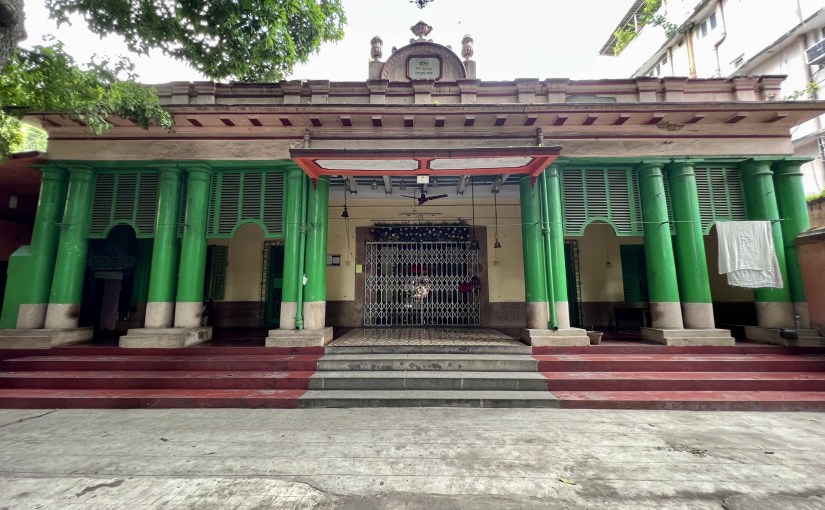
Janmastami is a festival normally held in the Bengali month of Bhadra (August – September) every year after Jhulanyatra. It is celebrated in many households, temples and even in thakurbaris in and outside Kolkata. One of them is Beltala Ghosh Thakurbari situated at 12, Naresh Mitra Sarani (previously Beltola Road), Kolkata – 26.
This thakurbari belonged to the estate of Shree Shree Iswar Radha Ballav Jiu Thakur and Shree Shree Iswar Radharani Jiu Thakurani. It was built in 1885 but the deities were established much earlier in the Bengali month of Baisakh, 1259 Bangabda, ie 1852 A.D.

As one enters the temple complex one will come across a beautiful dalan-shaped temple resting on six pairs of pillars of which three pairs are on either side. The temple is managed by a managing committee comprising of twelve members of Ghosh family. Daily worship is performed here. The temple remains open in the morning till 11:30 am and again in the evening from 4:00 pm to 8:30 pm. All major festivals of Lord Krishna are held here. The festivals include Jhulanyatra, Janmastami, Nandautsav, Radhastami, Rashyatra and Dolyatra. It was said that Dolyatra is very famous here. On that day, the deities are taken out from the main temple and placed on a singhasana (throne) in the courtyard so that the devotees can offer puja. Only on that day they can touch the idols of Radha Ballav and Radharani.
Now coming to the history of the temple. The Ghosh have five brothers – the first three of them being Nabin Krishna Ghosh, Raj Krishna Ghosh and Gopi Krishna Ghosh. According to Shri Pradip Kumar Ghosh who happens to be a senior member of Ghosh family, one of the brothers said that he would become a sadhu and stay at Brindaban. Now in order to keep that person within the family, Nabin Krishna Ghosh said that he would install the idols of Radha Krishna. In this way the idols were installed in 1852 at a place in Khiderpore.
The Ghosh family were originally from Taheli, a village in Budge Budge in erstwhile 24 Parganas district (at present South 24 Parganas). At that time for the construction of dock there was acquisition of land in Khiderpore. So the family was shifted from there. With the compensation amount received they bought a piece of land at Beltala area and founded this temple and installed the idols there. Out of the five brothers, later two of them left. The remaining three members of the family, the names of whom are mentioned above started looking after this temple and now their successors.
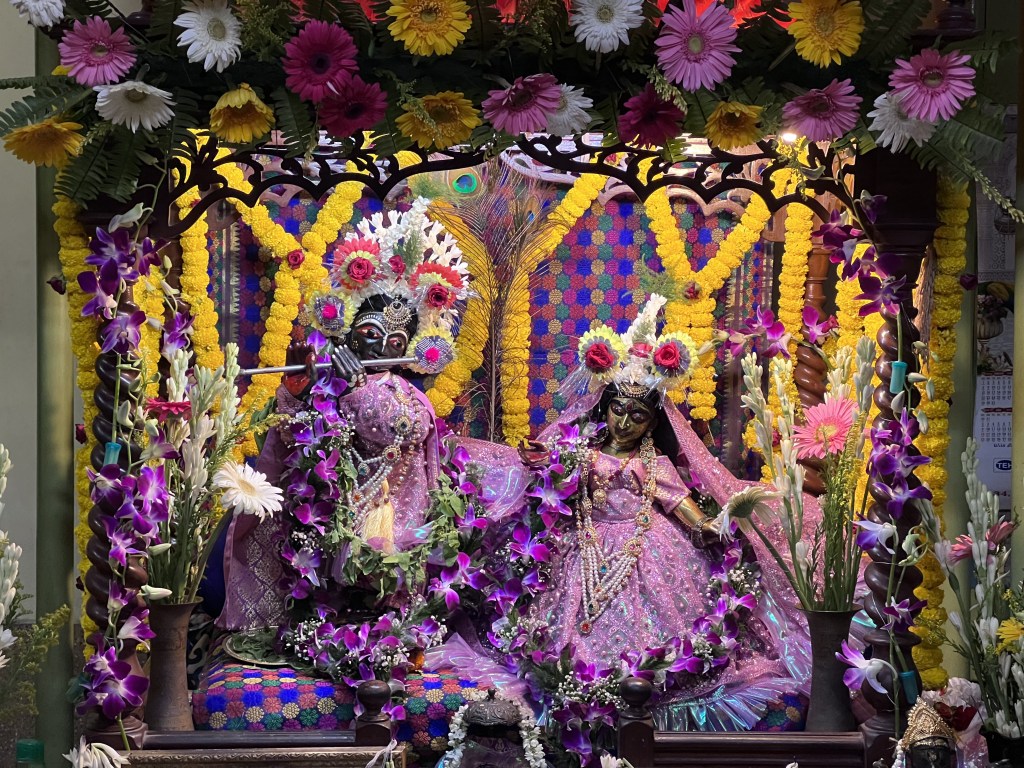
The idol of Radha Ballav is made out of kasthipathar (touchstone) and is brought from Jaipur in Rajasthan while that of Radharani is made of astodhatu (an alloy of eight metals). Among the festivals celebrated here special mention may be made of Janmastami and Dolyatra. During the festival time, the temple compound is full of people of varying age groups – family members, devotees and invitees. In the evening of Janmastami, the ritual of abhishek of Radha Ballav is held amidst chanting of hymns and sounds of conch shells. Nandautsav, which is held on the following day of Janmastami is equally celebrated here with great pomp and splendour.
Special thanks to Smt Aruna Ghosh and Shri Pradip Kumar Ghosh
Date of posting: 25th August, 2024.

 Blog of Kinjal Bose
interesting piece of history. thanks dada
LikeLike