
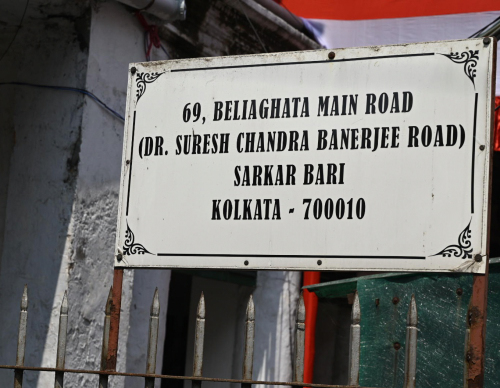
Maa Durga is worshipped in many bonedi houses of West Bengal including Calcutta (now Kolkata). The bonedi houses are there in north, central and south Kolkata. But Sarkar Bari situated at 69, Beliaghata Main Road, Kolkata – 700010 happens to be one of the few houses of East Kolkata where Durga Puja is celebrated in a grand way from 1892 onwards at their thakurdalan.
Beliaghata, during that time was not so populated; rather the area was a marshy land with swamps. Earlier there happened to be a waterway, though at places, it became shallow which was connected with Bidyadhari river. Boats of varying sizes used to come through this channel and anchored there.
A gentleman named Gagan Chandra Sarkar used to live at Jhinaidaha in Jessore district (now in Bangladesh). He came to Beliaghata in and around 1870s in search of fortune and became successful in the business of fishies. Later he was successful in taking lease of some of the bheries and later on he was able to purchase about nineteen of them. He became rich and started buying lands in and around Beliaghata and established himself as the zamindar of Beliaghata. Around 1886, he brought his elder brother Ramcharan Sarkar along with his family from Jhinaidaha.
Gagan Chandra Sarkar built his palatial residential house, the present Sarkar Bari, along with a thakurdalan and the construction of the same was completed in 1892. In the same year he started Durga Puja at the thakurdalan of his house. It was said that the first construction was laid down at the said thakurdalan. Gagan Chandra died in 1905. He was survived by his daughter Haridasi and his adopted son Ganapati Sarkar. At the time of his death, Gagan Chandra left behind a WILL, by virtue of which his own son Ganapati Sarkar and the two sons of Ramcharan Sarkar, namely Surendranath Sarkar and Bidhubhusan Sarkar jointly started conducting the Durga Puja thereafter.
Ganapati Sarkar was a learned man and he was writer of many books including a book named “Kalika Purania Durga Puja Paddhati” which he wrote in the year 1923. Since then the Durga Puja of Sarkar Bari has been following the same for the purpose of puja.
The kathamo puja is held on the auspicious day of Janmastami. The protima is built at the thakurdalan by the successors of the first artisan – Gopal Pal. Previously there was a tradition of Kumari Puja and Sadhaba Puja in this house but since the death of the wife of Ganapati Sarkar in 1936, it was stopped. However, Kumari Puja was later held for a short while from 2003 to 2006.
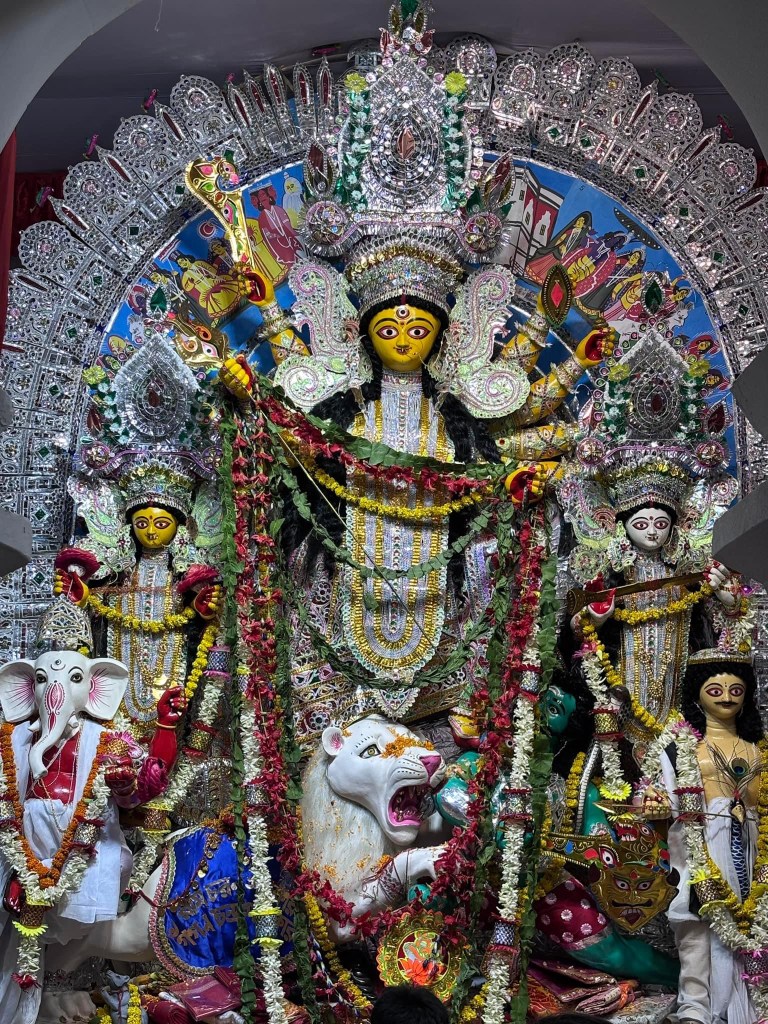
Presently, the puja is held by the heirs of Ganapati Sarkar, Surendranath Sarkar and Bidhubhusan Sarkar in turn (pala). The goddess at Sarkar Bari is unique in the sense that the eyes of Devi Durga is not the traditional mriganayani chok but its more of patalchera style. Some people term it as Bangla or Narayani chok but no specific definition is available. It is unique in all respects. I personally have not seen any goddess with this unique eyes. It will surely draw one’s attention.

On Saptami, nabapatrika is bathed at the family pond on the backside of thakurdalan. Dhanya Lakshmi or Griha Lakshmi is placed by the side of nabapatrika and is kept there till the puja is over. No annabhog is offered instead luchi and payesh are given to Maa Durga. Fruits, sweets and things prepared from coconut including naru are offered to the goddess. Naibidya is offered to Devi Durga during the days of the puja – on Saptami 17, on Astami 28 and on Nabami 29. No sacrifice is performed but pumpkin and chalkumro are offered as mere symbol. The members of Sarkar family have vegetarian diet from Sasthi to Nabami. They eat non-veg (fish) only after seeing the reflection of the goddess in the mirror on Dasami and then they start the rituals of baran.
Earlier, because this puja was the only puja in the area, it used to attract people in large numbers. Fair used to be held outside Sarkar Bari and within the courtyard, yatras, theatres and cinemas (through 16mm projector) were held and audience used to come in large numbers from the locality. Many famous personalities like Chhabi Biswas, Jawhar Roy, Bhanu Bandopadhyay, Mukundu Das and others have graced the occasion.
Special thanks to Shri Subhajit Majumdar.
Date of posting: 12th October, 2024.

 Blog of Kinjal Bose